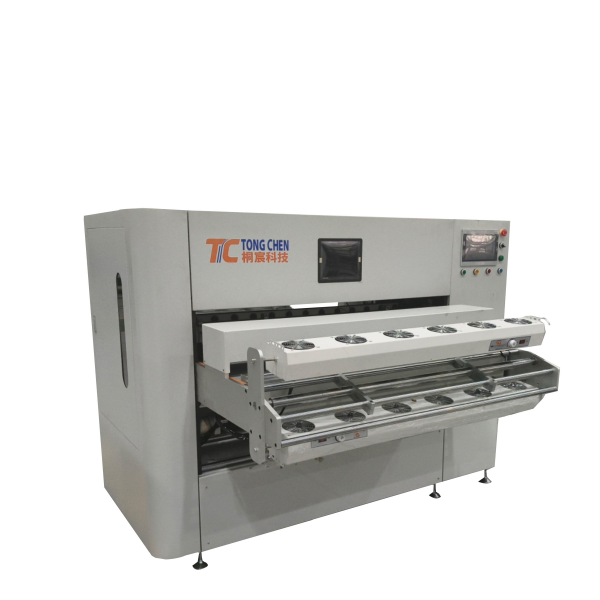
In mass production of PTFE filter pleating, pleat springback is the most common and yield-impacting pain point — especially for products with pleat heights above 50mm. Freshly folded filter media often relaxes, loses height, or even becomes unassembled after sitting for hours. Many factories simply crank up the heating temperature, which instead causes membrane shrinkage and micropore damage.
In reality, taller pleats create far stronger bending internal stress, placing stricter requirements on heat-setting temperature, dwell time and heating uniformity. This blog focuses solely on springback in tall-pleat PTFE production, breaks down the root causes, and provides actionable parameter tuning solutions to stabilize pleat geometry and reduce rework rates.
PTFE has a highly stable molecular structure and strong elasticity. Mechanical bending creates internal stress; heat setting works by relaxing molecular chains, releasing bending stress, and locking the fold angle upon cooling. The taller the pleat, the more severe the problem, for two core reasons:
1. Exponentially rising bending stress
When pleat height increases from 20mm to 100mm, material stretch and internal stress at the fold root rise dramatically. Standard temperature and heating time cannot fully release the stress, leaving stronger molecular rebound force after cooling.
2. Harder heat penetration
Taller pleats mean more stacked layers and a thicker fold root. Single-sided or short-duration heating only sets the surface layer; internal stress remains unrelieved and causes gradual springback over time.
This is exactly why low-pleat products run stably with standard parameters, but quality issues appear frequently as soon as you switch to taller pleats.
For the 8–150mm pleat height range, you can adjust parameters stepwise following the rules below — no blind temperature increase needed, balancing both forming stability and membrane performance.
Take standard medium-thickness PTFE composite filter media (0.2–0.5mm) as the baseline. Raise the set temperature for each pleat tier:
Critical limit: No matter how tall the pleat is, the set temperature must stay at least 15°C below the 260°C deformation threshold. Always calibrate actual temperature measurement points in real time to avoid local overheating that causes PTFE micropore collapse and reduced filtration efficiency.
Setting effect = temperature × heating duration. Raising temperature alone without slowing down will still cause springback, as the fold root does not receive enough heat.
Prioritize extending dwell time by lowering speed rather than increasing temperature drastically. This best preserves membrane properties and reduces shrinkage deformation risk.
Single-sided heating is the hidden cause of tall-pleat springback: the surface layer sets properly, but stress remains on the inner and reverse sides of the fold root, causing slow springback from inside out.
1. Higher temperature = better forming
Above 240°C, PTFE undergoes irreversible thermal shrinkage, deforming membrane pore size and losing filtration precision — creating more scrap instead of reducing it.
2. Increasing blade pressure to replace heating
Forcing the fold by mechanical pressure only damages filter membrane fibers at the fold root. It may look sharp initially, but the pleat will break and loosen much faster during service.
3. Cutting and unloading immediately after forming
Molecules remain active right after hot forming. Immediate cutting and stacking deform the pleats under external force. Allow the media to cool slowly on a flat output table for 3–5 minutes before moving to the next process.
Our TCZZ150-1300 full-automatic servo blade pleating production line is purpose-built with hardware configurations to solve tall-pleat forming challenges in PTFE media, reducing tuning difficulty and springback risk from the source:
Springback in tall-pleat PTFE filters is essentially a mismatch between bending internal stress and heat-setting energy. You do not need to pursue extreme temperatures. By matching temperature stepwise to pleat height, slowing down line speed accordingly, and ensuring double-sided uniform heating, you can achieve stable permanent forming without compromising membrane performance.
If you have been struggling with springback issues in tall-pleat PTFE production, our technical team can provide targeted equipment parameter tuning solutions. Feel free to contact us for details.
Whatsapp : +86 18955268651
Whatsapp : +86 18656924956
Whatsapp : +86 17718236977
Whatsapp : +86 17755275199
อีเมล : minjuan0526@163.com
โทร : +8618955268651 Mrs.Min +8618656924956 JullyZhang +8617718236977 Nina Peng +8617755275199 Lisa Lee
Xinghua Road Entrepreneurship and Innovation Incubation Industrial Park, Yuhui District, Bengbu Subdistrict
ลิขสิทธิ์ © 2026 บริษัท เบงบู ตงเฉิน ออโต้ซิ่ง เทคโนโลยี จำกัด. สงวนลิขสิทธิ์
ฝากข้อความไว้
สแกนไปยัง WeChat :
สแกนไปยัง WhatsApp :